- Home
- Categories
- Cities
- Blogs
-
Go to Searching & Listing Page
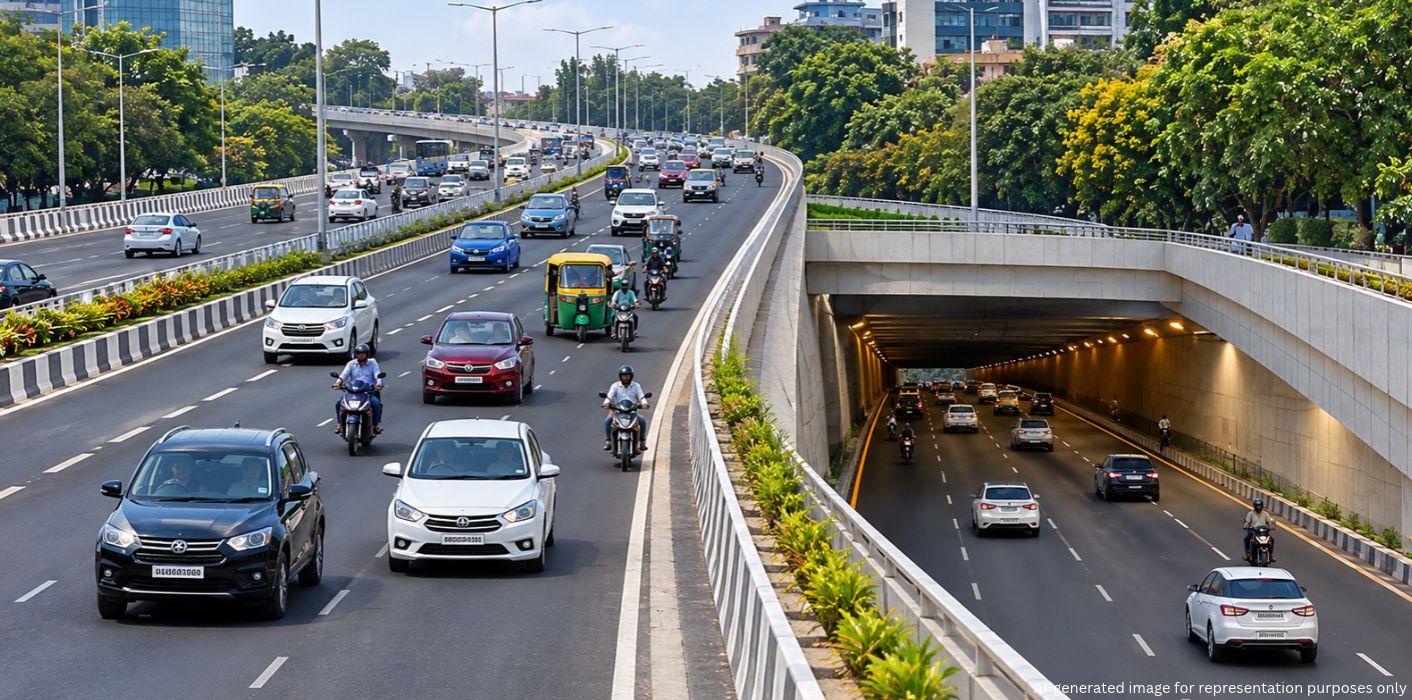
North Bengaluru’s airport-bound roads have struggled with traffic congestion for years, with improvements at one junction often creating delays at another. The ₹725-crore Mehkri Circle flyover project introduces a combined elevated corridor and underground tunnel to improve traffic movement along Ballari Road (NH 44). With construction underway, the integrated design could ease congestion, improve airport connectivity and make daily travel more predictable.
Ballari Road is a major route to Kempegowda International Airport, carrying airport taxis, buses, freight vehicles and private transport. Heavy traffic, particularly during peak hours, creates long queues around Hebbal and Mehkri Circle.
Previous interventions, including additional lanes and loops at Hebbal, have struggled to resolve the wider problem. Clearing congestion at one junction often pushes the traffic buildup further along the road.
Expanding the existing highway is also difficult because of developed properties, institutional campuses and defence land. The new project addresses these challenges by creating routes above and below ground rather than relying on extensive surface road widening.
The Karnataka Cabinet approved the integrated project in December 2025 after authorities reconsidered an earlier proposal for a 17-km twin tunnel. Preliminary groundwork, including soil investigations, began in October 2026 under the Bangalore Development Authority (BDA). The estimated project cost is ₹725 crore, including land acquisition and utility shifting, while the main construction contract is valued at approximately ₹440 crore.
The project combines two major components:
The hybrid design also addresses concerns about the earlier long-tunnel proposal, which would have restricted two-wheelers and autorickshaws. The revised approach aims to accommodate local travel needs alongside longer-distance traffic.
According to an IIT Bombay report, the integrated project could reduce congestion along the corridor by approximately 60% to 80%, depending on traffic conditions. Its benefits could extend beyond faster journeys to improvements in local accessibility and transport efficiency.
The main beneficiaries include:
The project also aims to reduce fuel wastage and vehicle emissions caused by stop-and-go traffic. By diverting through-traffic, it could create more space for local vehicles, public buses and pedestrians.
Environmental concerns remain part of the implementation process. Authorities are exploring tree transplantation, with approximately 50 to 60 trees reportedly facing removal. Discussions with non-governmental organisations are also underway to identify ways to preserve more trees.
The project follows years of debate over how to manage north Bengaluru’s growing traffic. A proposed steel flyover in 2016-2017 was abandoned following strong environmental and civic opposition over the planned removal of more than 800 trees. Subsequent road improvements failed to resolve congestion across the entire corridor, prompting the shift towards an integrated solution.
With an 18-month construction timeline, the project is targeted for completion by mid-to-late 2028, provided work proceeds without prolonged delays. Its impact will depend on the coordinated execution of the elevated corridor and tunnel, resolution of legal hurdles and successful integration with surrounding roads.
1. What is the Mehkri Circle flyover project in Bengaluru?
The Mehkri Circle flyover project is a ₹725-crore integrated road development in north Bengaluru. It combines an elevated corridor between Mehkri Circle and Baptist Hospital with a three-lane-each-way underground tunnel extending beyond Hebbal flyover.
2. Why is the Mehkri Circle flyover project being developed?
The project aims to address persistent traffic congestion along Ballari Road (NH 44), particularly around Hebbal and Mehkri Circle. It is designed to improve airport connectivity and prevent traffic bottlenecks from shifting between junctions.
3. What are the main features of the Mehkri Circle flyover project?
The project includes a two-lane-each-way elevated corridor, a three-lane-each-way underground tunnel and an elevated rotary at Mehkri Circle. The rotary will also connect with the proposed Yeshwantpur–KR Pura east-west corridor.
4. How much traffic congestion will the Mehkri Circle project reduce?
An IIT Bombay report estimates that the integrated Mehkri Circle flyover and tunnel project could reduce traffic congestion along the corridor by approximately 60% to 80%, depending on traffic conditions.
5. Who will benefit from the Mehkri Circle flyover project?
Airport commuters, business travellers, residents of Hebbal, RT Nagar, Ganganagar and Sanjaynagar, two-wheeler riders, autorickshaw users and freight operators are among the primary beneficiaries. Improved connectivity could also benefit businesses and property developments around Hebbal, Yelahanka and Devanahalli.
6. When will the Mehkri Circle flyover project be completed?
The Mehkri Circle flyover project has an 18-month construction timeline and is targeted for completion by mid-to-late 2028, subject to construction progress and resolution of the legal hurdles affecting the tunnel section.